Seguridad
Your inbox clean. Threats, out.
Corporate Antispam managed by Seintec to reduce spam, phishing, malware, and malicious mail before it reaches your users.
We protect corporate email through different layers of analysis, filtering, and security policies tailored to each organisation. Seintec configures, manages, and maintains the service so your users can focus on their work.
The starting point
A single convincing email is enough to put a company at risk
Email remains one of the primary channels used to attempt to deceive users, distribute malicious files, steal credentials, or initiate fraud.
- Increasingly convincing phishing, capable of mimicking the organisation’s everyday processes
- Apparently normal links and files that lead to fraudulent pages
- Too much noise: spam consumes time and multiplies daily decision-making
- The individual as the last line of defence when all threats reach their inbox
Our response
Filter before delivery
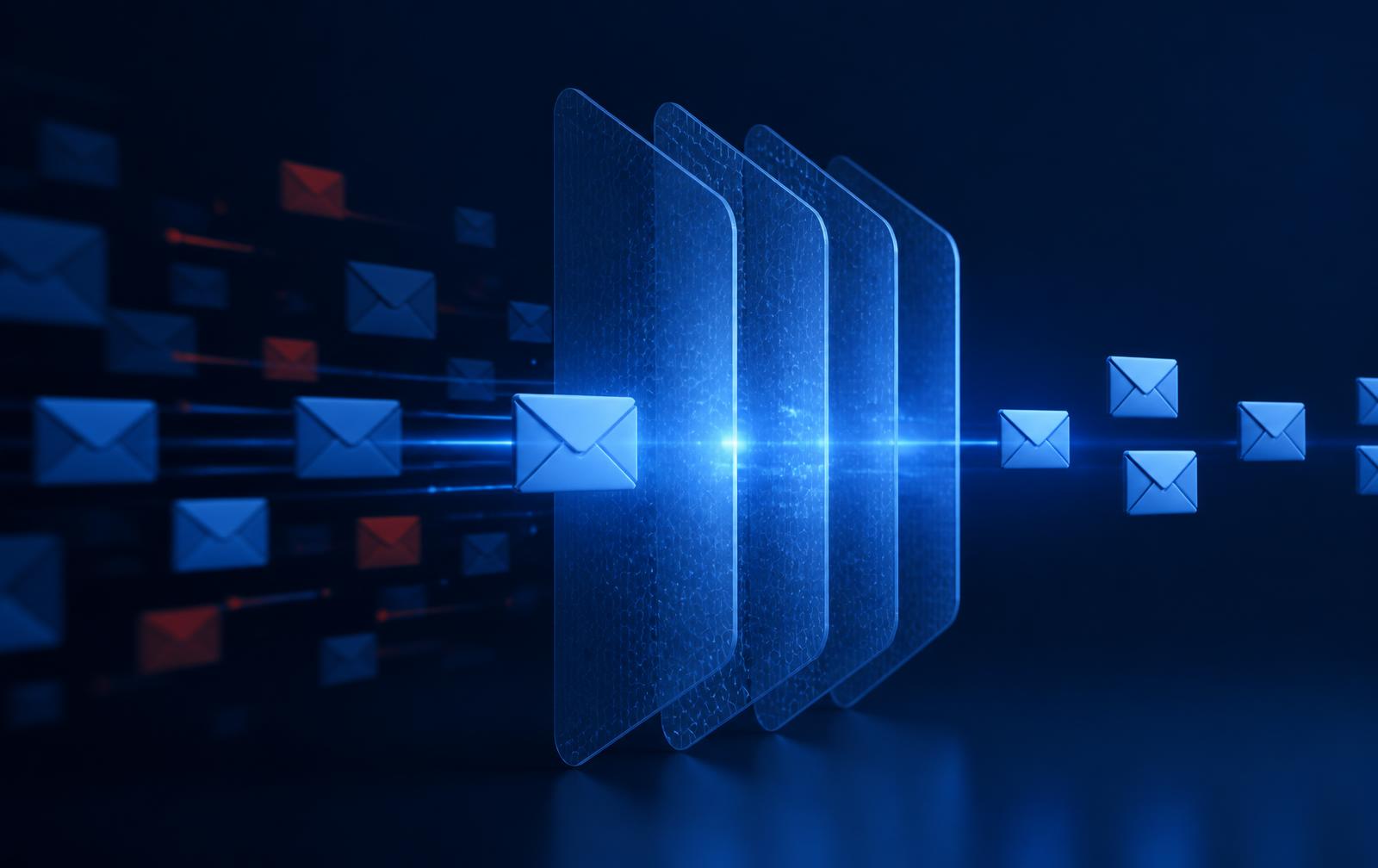
The Seintec Antispam service analyses email before delivering it to users, applying multiple controls to identify unsolicited or potentially dangerous messages.
- Fewer threats in the inboxReducing the volume of spam, phishing, malware, and suspicious messages reaching the user.
- Fewer high-risk decisionsThe fewer fraudulent messages a person receives, the fewer opportunities there are to make a mistake.
- Increased productivityLess junk mail means less time spent reviewing irrelevant messages.
- Tailored policiesConfiguring rules according to users, departments, domains, and specific requirements.
- Controlled quarantineIsolating specific messages from the inbox until they can be reviewed.
- Seintec managementConfiguration, support, administration, and service evolution via a single point of contact.
How it works
Multiple analysis layers before reaching your inbox
Every message passes through various complementary controls. No single layer acts alone: the result is the sum of them all.
Reputation
Analysis of the origin and various signals associated with the sender.
Identity
Validation of specific domain and sender characteristics.
Content
Analysis of the message and potentially suspicious signals.
Links
Review of links included within messages.
Attachments
Analysis and application of file-based policies.
Policies
Specific rules tailored to the organisation.
What is included
Service capabilities
Multi-layered anti-spam filtering
Automatic detection and classification of unsolicited email through various signals.
Phishing protection
Controls aimed at detecting fraudulent messages designed to deceive the user.
Malware protection
Analysis intended to identify potentially malicious content distributed via email.
Attachment control
Application of policies on specific file types and content.
Link analysis
Evaluation of links included in messages to identify specific suspicious behaviours or destinations.
Quarantine
Isolation of messages requiring review or those that breach specific policies.
Quarantine reports
Ability to notify users regarding specific held messages based on established configurations.
Allow and block lists
Management of senders, domains, or exceptions whenever necessary.
Custom rules
Specific policies tailored to different organisational needs.
Inbound filtering
Protection of received email.
Outbound filtering
Application of specific controls on sent email when included as part of the contracted service.
Centralised management
Consistently managed security policies.
Advanced protection
Additional layers according to the selected service level
These capabilities can be incorporated depending on each organisation's architecture and requirements.
Advanced file analysis
Certain suspicious attachments may undergo additional analysis mechanisms before being deemed safe. Suspicious files can be analysed in a controlled, isolated environment to observe their behaviour.
Advanced link protection
Certain links can be analysed to reduce the risk of directing the user to fraudulent pages or malicious content.
Impersonation protection
We analyse signals that may indicate a message is attempting to impersonate an address, a colleague, a supplier, a client, or a known organisation.
Business fraud detection
BEC (Business Email Compromise) attacks attempt to impersonate trusted individuals or companies to trigger payments, banking changes, information delivery, or system access. Seintec can configure additional controls to reduce this risk.
QR code analysis
QR codes can be used to hide fraudulent links within an image. Advanced modalities can incorporate additional controls against this type of threat.
Email encryption
For certain sensitive exchanges, additional content protection mechanisms can be incorporated.
Email archiving
Centralised preservation and message searching according to operational, technical, or compliance needs.
Email continuity
For organisations where email is critical, the architecture can be extended with continuity mechanisms for specific primary platform downtime scenarios.
Social engineering
Email fraud does not always look like an attack
Most fraud attempts mimic everyday messages: an invoice, an urgent request from management, a change of bank account, or a shared document. Reducing the number of these messages reaching the user is the most effective way to mitigate risk.
Request email analysis- «I need you to make this transfer today.»
- «We have changed our bank account.»
- «Your password expires in a few hours.»
- «Check the document I just shared.»
Comparison
A basic filter is not a managed service
Basic antispam filter
- Junk mail
- Generic configuration
- Few policies
- Reactive management
- Siloed tool
- User as the last line of defence
Managed antispam by Seintec
- Spam, phishing and malware
- Corporate policies
- Attachment control
- Link analysis
- Managed quarantine
- Seintec management
- Cybersecurity integration
- Optional advanced layers
- Domain protection
- Technical support
Use cases
Where email is part of critical processes
Management
Sensitive messages, documentation, and impersonation risk.
Administration and finance
Invoices, payments, suppliers, bank account changes, and economic documentation.
Law firms
Confidential documentation, client information, and sensitive communications.
Tax consultants and agencies
Payrolls, tax documentation, financial data and high volumes of attachments.
Hotels
Bookings, suppliers, administration, invoices and external communications.
Businesses
Email as the core communication tool for clients, employees and suppliers.
Implementation
Email protection in four steps
- 01
Auditing
Review of domains, DNS, mail flow, platform, users and configurations.
- 02
Preparation
Configuration of policies, quarantine, rules and exceptions.
- 03
Activation
Controlled mail flow switchover when necessary.
- 04
Fine-tuning
Initial review of behaviour, false positives, quarantine, and rules.
- 05
Operations
Ongoing service management provided by Seintec.
Why Seintec
A managed service, not a licence
- Implementation: Seintec designs and deploys the service.
- Management: we administer policies, settings, and configurations.
- Support: a dedicated team is available to consult whenever an incident arises.
- Integration: Antispam is part of a broader infrastructure and cybersecurity strategy.
- A single point of contact: email, servers, cloud, backup, security, and support under one partner.
Global strategy
Antispam is one layer within a broader strategy
- Antispam
- MFA
- EDR/XDR
- Backup
- Cybersecurity
- Training
Email security is combined with identity, endpoint protection, backups and user training.
Frequently asked questions
Common enquiries regarding email security
- What is enterprise-grade antispam?
- It is a security system that analyses email before delivery to identify spam, phishing, malware, and other potentially unwanted or dangerous messages.
- Does it work with Microsoft 365?
- It can be used as an additional security layer in specific Microsoft 365 architectures. Seintec conducts a preliminary configuration analysis.
- Do I need to change Outlook?
- In most cases, users continue using their usual tools. The architecture is validated before implementing the service.
- What happens to suspicious emails?
- Depending on the configured policies, they can be blocked, rejected, or held in quarantine.
- Can I recover a legitimate email from quarantine?
- Yes, in accordance with the defined permissions and procedures.
- Can it block phishing?
- The service includes controls designed to identify specific phishing attempts. No technology should be presented as absolute protection.
- Does it protect against malware?
- It includes mechanisms to identify and block specific malicious content distributed via email.
- Does it protect against ransomware?
- It can prevent numerous emails, links, or files used to distribute ransomware from reaching users, but it must be part of a broader security strategy.
- Does it protect against CEO fraud?
- Advanced tiers can incorporate specific controls against impersonation, BEC, and targeted fraud.
- Can it protect my domain against spoofing?
- Seintec can review and configure mechanisms such as SPF, DKIM, and DMARC to improve domain control.
- Can there be false positives?
- Yes. That is why Seintec adjusts rules, exceptions, and policies to balance security and operational efficiency.
- Who manages the service?
- Seintec handles the implementation, configuration, administration, and support of the service.
Next step
Reduce the number of threats reaching your users
We review your domains, email platform, and security requirements to propose an Antispam architecture tailored to your organisation.